

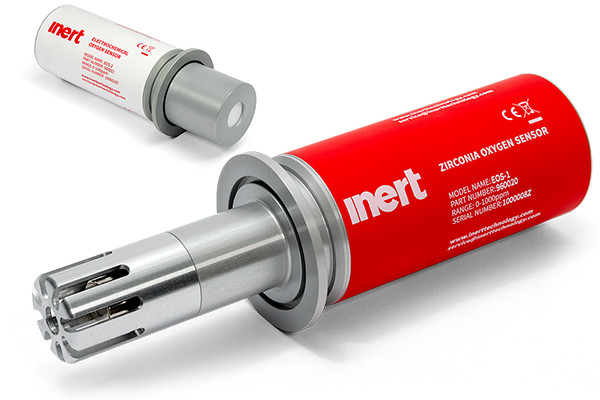
Can you ever have too much of a good thing? While oxygen may be essential to life, it can also be detrimental to many modern research methods and engineering processes. That’s why so many functions are performed in an airtight glove box, where the inside atmosphere can be changed to remove oxygen by purging, or with help of a recycling inert gas management system.
If going to such great lengths to protect a process, it’s absolutely essential that the device measuring oxygen levels be of sound design and the right model for the job. Whether you call these critical components oxygen sensors, oxygen analyzers, or trace oxygen monitors, in this blog update we explain what to look for in glove box oxygen sensors and why one style might be preferred, depending on the glove box application.
How low do sensors go?
The concept of how market demand always drives supply is certainly true in the oxygen sensor arena. Today, engineers and researchers require absolutely air-free environments. As such, the sensors used to measure for any presence of oxygen had better work to the lowest possible denominator, generally gauged in parts per million (ppm).
Not very long ago, sensors that measured down to 10ppm might have been considered adequate, but nowadays, even that small of a presence of oxygen could prove harmful to certain processes. Today, more glove box users need assurance that oxygen levels are
Sensitivities
The accuracy of oxygen sensors is usually communicated within a range, such as +/- .1ppm from 0 to 10ppm. However, the sensitivity of the sensor might be more critical, as mentioned earlier when
Losing sense
Glove box oxygen sensors are not meant to last the lifetime of a glove box. The sensitivity wears down over a few years, depending on a multitude of factors, such as frequency of use, and exposure to solvents, volatile chemicals — or too much oxygen.
At Inert, we suggest a proactive approach to our customers for peace of mind: join our sensor exchange program. After learning in what application a sensor is to be used, our experts can estimate a timeline of when to send new sensors, thereby prompting glove box users to do the easy swap at an interval that makes the most sense. Best of all, the old sensor is then sent back to us for recalibration so it can be used again.
Good sense
Safety should also be considered when choosing an oxygen sensor. In the presence of solvents or volatile metal organics, it’s smart to use an electrochemical oxygen sensor to avoid an adverse reaction, as a zirconia-based sensor might create under certain conditions in the presence of those materials. Otherwise, a zirconia model is usually considered standard.
Coming to one’s senses
A glove box user needn’t settle for unsatisfactory results, high prices, poor service, or inadequate response time. There’s always an alternative option. When a glove box sensor fails to meet expectation, try a sensor from a different company than that which made the original glove box. This kind of aftermarket adjustment happens more than you might think!
The fit shouldn’t be an issue because sensors are sized for similar leak-tight connections on glove boxes via a KF-40, industry standard flange, or an adapter can be easily used. If the electrical connection is different than a standard 24V DC, an off-board display unit can be installed. There’s always a way to make it work!
To be sure you are using the best sensor for your glove box application, talk to us. We rigorously test all sensors onsite before shipping to customers. Maybe we can breathe new life into your older machine, getting you better results than ever before. Call us at 978.462.4415.