

Positive pressure gloveboxes are employed by companies around the world to enclose a variety of manual and automated manufacturing processes from 3D printing and welding, to semiconductor, solar cell, LED, Lithium ion (Li) battery, medical device, pharmaceutical, and chemical production. As many of these processes require a particle-free, non-reactive, inert atmosphere, argon or nitrogen gas is commonly introduced into the glovebox chamber to create the ideal, non-volatile, working environment. (A common industry goal is maintaining 2) and water (H2O) vapor, which in comparison to clean room standards, would be better than a class 10 environment). Traditionally, trained operators will manually fill and purge, and visually monitor the gas and effectively “dial-in” the atmospheric condition.
There are 4 known pitfalls of a manual approach, however, that continue to raise the urgency in many factories to adopt more sophisticated, digitally-controlled glovebox systems.
1. In the time it takes to make a tool change, or to process even a small lot, subtle to dramatic fluctuations in the environment can occur. This can result in product losses during final inspection, or worse, allow undetected lower reliability lots to get shipped.
2. Safety procedures relative to regulating the proper atmospheric condition is often trained and built into a manufacturer’s human process. Since excessive levels of oxygen or water vapor are volatile in certain procedures, serious safety concerns are raised if, say, the trained operator goes out sick and production is left to a less experienced operator.
3. Argon and nitrogen gas consumption in many factories is a notable expense. Taking a fill and purge approach, which also includes downtime, is recognizably low in efficiency, especially as compared to a digitally controlled gas management system which filters and recycles the argon or nitrogen gas continuously.
4. Manual processes will, at-best, have a nearby PC-based or hand-written documentation process with broad log times. Whereas today’s digitally managed systems will log traceable data for every second the glovebox is in operation and will auto-correct themselves instantly. Data can also be shared anywhere in the world it’s being managed, often through a Machine-to-Machine (M2M) or IoT network.
As more stringent regulations over consistent quality and repeatable processes trickle down from Tier 1 military and aerospace suppliers into the dialogue of all electronic and electro-mechanical suppliers, our most reliable and efficient gloveboxes with integrated gas management systems are increasing in demand for critical, controlled processes. For production, Q/A, and supply chain managers who are looking for improved repeatability and documented lot-to-lot data, and researchers developing unique workflows, and exploring new material and chemical combinations, the sophistication of a digitally controlled system is becoming crucial.
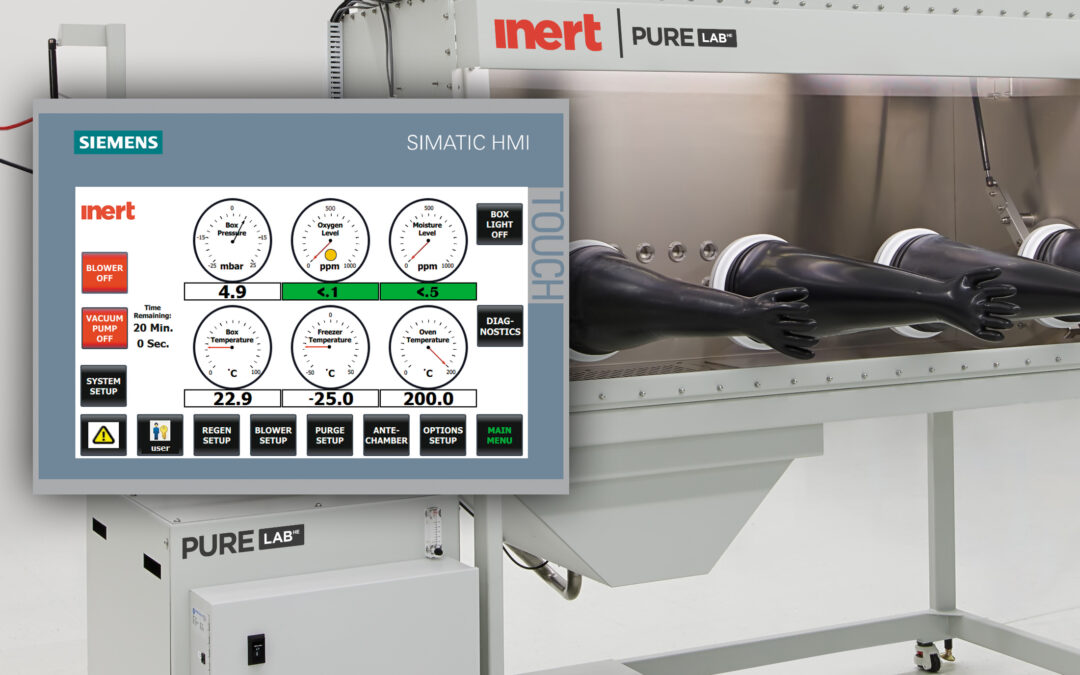
As gas monitoring and control requirements have evolved, so too have the digital electronics and programmable logic controllers (PLCs) that enable it. Capitalizing on this trend, we recently partnered with Siemens to centralize our approach, and as a result, our PureLab HE 4GB 2500 glovebox system is becoming one of our most popular customizable glove box solutions. This (4) four glove (or (2) two station) hermetic enclosure system is employed in research and development labs at universities and at various factories performing any number of device manufacturing or assembly (including OLED and semiconductor), welding (ARC, Tig, or Laser), and 3D printing (additive manufacturing) procedures. It’s space requirements of 10 ft. (W) X 6 ft. (T) X 3.5 ft (D), and internal work space of approximately 8 ft. (W) X 3 ft. (T) X 2 ft.(D), combined with its robust steel construction (capable of handling 550 lbs. on each of four, or six, casters), make this a versatile glovebox for many manufacturing, fabrication, manual- and automated-assembly, and research procedures. Designed as a modular system, PureLab HE also allows for pre-delivery and onsite add-ons and customer-specific tooling and custom configuration.
From Siemens’ Totally Automated Integration (TIA) portfolio, Inert selected the SIMATIC S7-1200 programmable logic controllers (PLCs) and SIMATIC human-machine interface (HMI) color panels. The Siemens PLCs offered us high-reliability regulation of a multitude of our critical, automated system requirements, such as temperature and airflow compensation. With the common engineering framework of the TIA platform, multiple gas management systems can be managed from a single interface, and color HMI panels can be tailored to specific languages and protocols. Data retrieval is easily done on touch screens or from the convenience of a centralized PC. These options present a unique customer opportunity for remote access to system diagnostics, as well.
As device and system designers and manufacturers around the world are being pushed by mil/aero OEMs to assist them in meeting their commercial-off-the-shelf (COTS), and Size, Weight, Power and Cost (SWaP-C) objectives (while still meeting their stringent quality standards such as defined by AS9100)―as well as by medical OEMs to meet the revised regulatory standards of ISO 13485:2016―so too are their facilities and assembly lines advancing. While clean room technology is ever-present, an often-overlooked solution to various manufacturing challenges is the micro-environment commonly referred to as “the glovebox”. With today’s levels of hermetic achievement and digital control, you can see how they’re now at the forefront of things to watch evolve in tomorrow’s advanced manufacturing centers.
For more information on the Siemens/Inert collaboration, read the case study here >>
To learn more about the PureLab HE System Family, click here >>