

Teaching you how to protect your investment is important to us at Inert. While we offer a variety of Service Plans to support in-house maintenance on glove box enclosures and gas management systems, we take every opportunity to help our customers better understand their own glove box equipment. This knowledge almost always results in our customers saving money!
We find that when the little things go overlooked, production can grind to a halt. Therefore, here we are going to explore the top components that are potentially wearing out on your enclosure, why it’s happening, and, whenever possible, what might be done to achieve greater durability.
Gloves
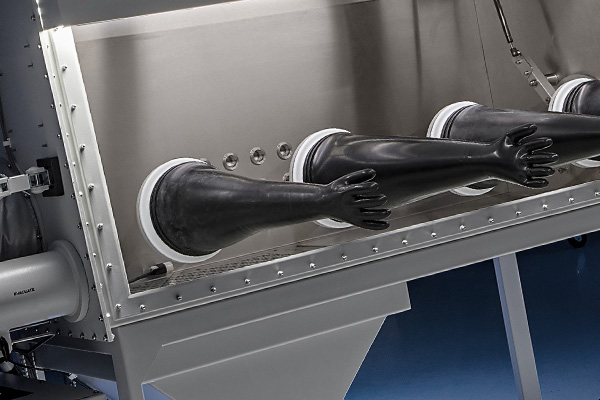
When speaking of glove box systems, gloves are the weakest point of contact. The constant insertion and extraction of user hands causes natural friction and eventual breakdown. Rips most often occur when workers wear rings and watches, or use sharp instruments inside the enclosure. Even pens poking out of shirt pockets have caused untimely tears. To maintain glove safety and potentially extend the lifespan, Inert recommends you remind users of these common mistakes and update your quality control measures as necessary.
Filters
Like most consumable components, how long a filter lasts depends much upon its application. Heavy powder use generally wears out filters faster. If it’s possible to reduce the amount of powder, or periodically collect it, filters should last longer.
Carbon Filters
There to protect the catalyst by absorbing solvent vapors, carbon filters are another consumable, not meant to last forever. The more solvents used, the faster these filters wear out.
Purifying Column Charges
The purifying column charge may not be something you think about day to day because it rarely needs changing. However, chemical poisoning in the column could reduce that lifespan, so it’s important to monitor it closely.
O-Rings
Ordinary use of a glove box system will necessitate occasional replacement of glove o-rings and antechamber o-rings. When ultraviolet (UV) exposure is included in the mix, we see o-rings break or breakdown faster. Therefore, if UV exposure is common in and around your glove boxes and gas management systems, we recommend checking the quality of o-rings more often, depending on level of exposure.
Windows
Scratches and clouded glass are the most common reasons a glove box window needs to be replaced, usually when the user’s sight is hindered in some way by the marks. To minimize window damage, be careful with sharp objects or laboratory equipment that is in and around the enclosure.
Molecular Sieves
When a glove box application requires heat, we see molecular sieves wear down more quickly. Chemical exposure and regeneration methods are also part of the equation.
Blowers
The life expectancy of a blower is directly correlated to the speed it is run and the quantity of solvents used in the glove box application. Some blowers work consistently for many years, while others quit in just a few. To protect enclosure blowers and extend lifespans, institute a solvent-removal system to collect vapors and minimize blower exposure.
Valves
Similar to blowers, we see valves wear out most frequently when large quantities of solvents are used inside an enclosure without a proper solvent removal system.
Pump Oil
With this, there are really two components to consider: the oil and the pump. If the pump stops working correctly, the lifespan or quality of the oil is moot. Be cognizant of what the pump comes in contact with because exposure to water and other materials can affect its mechanics.
The pump oil is considered another consumable, requiring replacement regularly. We take that standard a step further to recommend changing it after regeneration and if the oil becomes discolored. Remember, pump oil should be clear.
Preventative Maintenance
In our experience, glove boxes and gas management systems last longer when there is a program in place to keep everything in tip-top shape. To help protect your investment and your company’s productivity, Inert can develop a preventative maintenance program specific to your system. We have the experience to know what maintenance procedures are needed and when — on any enclosure system in the world. If we can be of help to you, please call us at 978.462.4415